
NFT Metadata: Everything You Need To Know
- Mimic NFTs
- Jan 20
- 10 min read

Nft Metadata is the quiet infrastructure behind every tokenized asset. It is the structured description that tells wallets, marketplaces, and experiences what an NFT represents, where the media lives, and how it should behave. Without it, a token is just a number on a ledger.
In production terms, this descriptive layer is the call sheet for your collection. It names the asset, points to the media files, lists traits and rarity, specifies royalties, and often encodes logic for future upgrades or interactive behavior. Well structured Nft Metadata is the difference between a fragile collection and a long lived digital asset that can travel across wallets, games, apps, and immersive experiences.
If you are new to tokens themselves, you might want to start with a clear explanation of what NFTs are in practice, then return here to dive into the data that drives them, for example a clear explanation that breaks down what NFT ownership actually means on chain and off at the Mimic NFTs editorial hub on what NFTs are in human language.
Table of Contents
What NFT metadata actually is
At the most basic level, metadata for a token is a structured data document, usually in JSON format, that describes the asset attached to a blockchain entry. It is not the artwork or media itself. It is a set of fields that make the token understandable to software.
For a typical collectible, that document will hold a name, a description, a link to the primary media file, a thumbnail or preview, and a list of traits. In more advanced projects, it can also embed animation references, sound, multiple resolution versions, interaction hooks, and pointers to external APIs or game logic.
In film and game pipelines, we are used to shot metadata, asset databases, and scene descriptions. NFT data plays a similar role. It is the bridge between the immutable token and the mutable ecosystem of render engines, game clients, galleries, and metaverse spaces that need to know how to load and present that asset.
How metadata is structured at token level

Most major NFT standards, such as ERC seven two one and ERC eleven five, expect each token to resolve to a URI. That URI points to a metadata document, usually served over HTTP or a content addressed system like IPFS.
Inside that document you will usually find fields such as
name
description
image or animation URL
attributes
external URL
creator or artist information
royalty information, often implemented through separate standards
The attributes array is especially important in generative collections. It carries each trait and its value, for example
background: blue
outfit: tactical suit
expression: neutral
rarity tier: legendary
Marketplaces rely on these fields to filter, sort, and display rarity. Game engines and XR scenes can read the same fields to decide which model, texture set, or animation rig to load.
For a studio that builds high fidelity digital humans, the metadata often needs to reference entire character stacks, not just a flat image. A single token may point to a neutral head scan, multiple expression blend shape libraries, body meshes, motion libraries, and shading presets that are resolved by different engines. That complexity must be abstracted into a clear, stable schema.
Where metadata actually lives

A common misconception is that everything about an NFT lives on the chain itself. In reality, almost all projects separate the token from the descriptive and media layers. The token lives on chain. The metadata document and media usually live elsewhere.
There are three broad patterns
Fully on chain metadata, where the descriptive fields are stored directly in contract storage or generated on the fly by on chain code
Off chain metadata, where the token points to a URI on a server or content network
Hybrid approaches, where critical descriptive data is on chain but heavy assets sit in decentralized storage
Fully on chain metadata is compact and expensive. Off chain approaches provide flexibility but introduce dependency on the storage provider. Hybrid models seek a balance.
For teams that care about longevity, the question is not only where the data is hosted today, but what guarantees exist that these URIs will continue to resolve in five or ten years. You can see a practical breakdown of how digital files, ownership, and experience layers interact in a piece that explains how digital NFT files and ownership work in production practice.
On chain versus off chain storage in depth

On chain descriptive data
When metadata is on chain, fields such as name, description, and attributes are stored inside the contract or computed deterministically. This gives strong guarantees that any node can reconstruct the information without external dependencies. It also increases cost and complexity.
For generative art and text driven pieces, this can be a virtue. The entire artwork, including instructions for rendering, lives inside the network. For high resolution character art, motion capture data, or full body rigs, the size quickly becomes impractical for direct on chain storage.
Off chain documents
In most collections, the tokenURI resolves to a JSON document hosted on IPFS, Arweave, or a web server. This allows creators to update or correct metadata early in the life of a project, for example to fix a typo or to reveal hidden traits. It also introduces responsibility. If that storage is not maintained, the NFT may still exist on chain, but wallets and galleries will no longer be able to load its description or media.
Well run projects treat this layer with the same seriousness as a film production treats its asset library. Files are version controlled, redundantly stored, and documented. The smart contract simply points into that well governed archive.
Hybrid strategies
Hybrid strategies might fix the core descriptive fields on chain while allowing external systems to supply live elements. For example, an avatar might have permanent base traits stored in an immutable way, while current outfit, environment, or state is loaded from a game server. This is particularly relevant for metaverse ready characters where identity and moment to moment appearance are distinct layers.
For creators interested in expanding their collections into immersive worlds, there is a dedicated exploration of how tokens intersect with shared worlds in this perspective on NFT projects that live inside the metaverse and connect to larger virtual experiences.
How metadata connects to files and experiences

Metadata is not valuable in isolation. Its value is in how reliably it points to and organizes media and behavior. In a character centered project, you might see
A primary render image used as the gallery thumbnail
A turntable animation reference used by web viewers
A real time ready mesh and texture set for engines like Unreal or Unity
Performance capture files for future animation updates
Sound files for voice or reactive ambience
The metadata document will typically link to one or more of these through URLs. External applications then decide which representation to prioritize. A marketplace might use the static image, while a virtual production stage loads the real time character rig.
For a studio like Mimic, which builds film grade digital humans, the challenge is to compress a very rich underlying asset stack into a manageable and future proof descriptor. That is why many teams work with structured naming conventions, version tags, and clearly partitioned folders mapped through metadata fields.
If you want to see how a specialized studio frames the overall production of token collections, from concept art to deployed experiences, the overview of creative NFT production services on the Mimic NFTs services page gives a broad view of how this data layer ties into the full pipeline.
Who is responsible for metadata quality
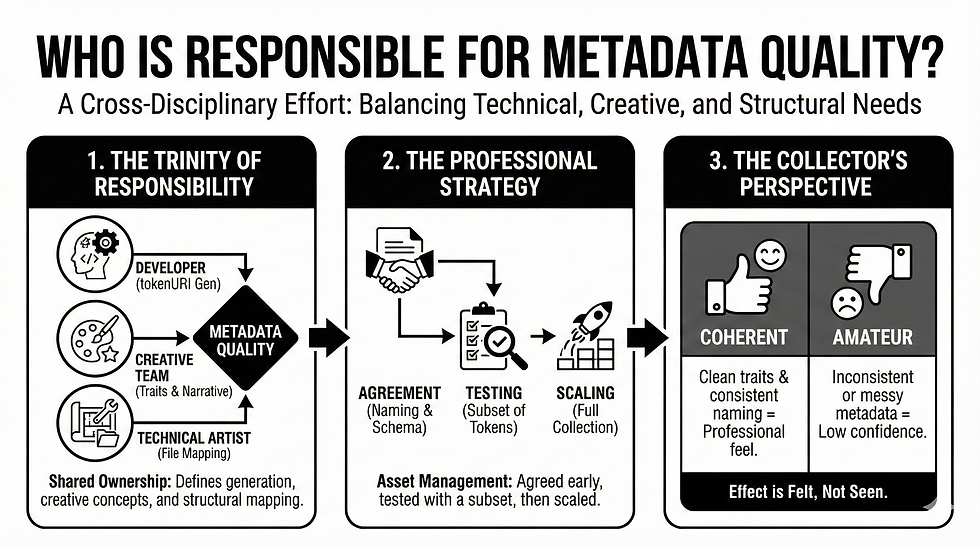
Responsibility for well designed metadata sits somewhere between the smart contract developer, the creative director, and the technical artist. The developer defines how tokenURI is generated. The creative team defines traits, rarity, and narrative categories. The technical artist or pipeline engineer decides how these maps to actual files and structures.
In a professional environment, this is treated as part of the asset management strategy. Naming, folder structure, and metadata schemas are agreed early, tested with a subset of tokens, and only then scaled to a full collection.
Collectors rarely see this planning. What they do see is the effect. Collections with clean traits and consistent naming feel coherent. Collections with inconsistent or messy metadata feel amateur, even when the artwork is strong.
Behind many curated projects there is usually a studio or team with experience in character databases and performance capture libraries. You can learn more about the background behind one such studio on the Mimic NFTs team and philosophy page, which outlines how years of digital human production inform how they think about tokenized assets.
Designing resilient Nft Metadata

If you are planning a collection, here are principles to treat as non negotiable when you design Nft Metadata
Keep a single source of truth for each token and its traits
Use consistent naming for attributes and values
Choose storage that aligns with your intended lifespan for the project
Document your schema for future collaborators
Plan for how you will handle corrections and upgrades
Resilience means that in five years, a new marketplace, game, or XR environment can still parse your tokens and know what to do with them. It means the descriptive layer has not become an archaeological puzzle.
A well designed metadata schema also becomes a creative tool. When attributes are thoughtfully structured, you can sample them to build visualizations, drive generative scenes, or feed machine learning systems that create new motion or states for your characters. This is where Nft Metadata becomes not just descriptive, but compositional.
Comparison table
Below is a compact comparison of three common approaches to storing and serving token metadata
Approach | Where data lives | Strengths | Tradeoffs | Typical use cases |
Fully on chain metadata | Descriptive fields stored directly in contract or generated deterministically by on chain logic | Strong permanence, minimal external dependencies, high integrity for archivists and collectors | Higher deployment cost, constrained data size, less suited to heavy media such as high resolution character renders or motion files | Generative art, text centered works, minimalistic collections prioritizing chain purity |
Off chain metadata on centralized servers | JSON documents and media hosted on web servers controlled by the creator or a platform | Flexible, easy to update early, simple to integrate with existing infrastructure | Risk of downtime or abandonment, requires ongoing maintenance and trust in the operator | Smaller projects, experiments, or collections tightly coupled to a single platform |
Off chain metadata on decentralized storage | Documents and media stored on networks such as IPFS or Arweave, addressed by content hashes | Greater resilience, content addressing makes tampering visible, community can pin and mirror data | Requires understanding of pinning and incentives, not instant protection against neglect | Collections that aim for long term availability, especially art and character libraries that may be reused in future applications |
Applications

Thoughtful metadata design unlocks more than marketplace sorting. It opens the door for an ecosystem of experiences around your collection
Art and collectibles: Traits drive rarity, series, and narrative arcs. Curators can build exhibitions around specific attributes, such as all characters with a certain expression or outfit.
Gaming and interactive worlds: For game ready avatars, metadata can describe species, class, stats, equipped items, and even animation sets. Engines read these fields to spawn the correct rig and behavior.
Music and audio projects: Audio centered tokens use metadata to map track versions, stems, cover art, and rights information. This enables future remix experiences and interactive listening environments. For a focused look at audio formats that work in practice, there is a dedicated exploration of music NFT formats that support artists in real distribution workflows.
Metaverse and XR identity: In immersive spaces, tokens represent persistent identities. Metadata describes base appearance, owned outfits, emotes, and sometimes reputation or progression. Well structured descriptors make it possible to move the same character across multiple virtual locations while keeping a coherent identity.
Virtual production and digital humans: For studios working with performance capture and realistic characters, tokens can act as access keys to entire character packages. Metadata in this context maps not only aesthetic traits, but also file references for geometry, textures, rigging setups, mocap takes, and even lighting presets.
Benefits

Investing time into metadata architecture delivers tangible benefits for creators, collectors, and platforms
Durability: Stable schemas and resilient storage protect long term value. Even if front ends change, the descriptive layer remains parseable.
Interoperability: Clear structure allows new applications to integrate your collection without bespoke work. This is essential for cross platform avatars and shared worlds.
Discoverability: Good trait design and naming make it easier for collectors to find pieces that resonate with them, and for curators to assemble themed sets.
Creative flexibility: When attributes are designed with intention, they can be reused to drive generative storytelling, interactive scenes, and AI assisted content.
Professionalism and trust: Clean metadata signals care. Serious collectors and collaborators notice when a project treats its data layer with the same respect as its visual design.
Future outlook

The next wave of token projects will treat metadata not only as a descriptor, but as an active interface. Several trends are already visible
Dynamic metadata: Tokens that update over time in response to on chain events, game progression, or real world data feeds.
Composable characters: Avatars whose identity is defined by a base token and a set of equipment or state tokens, all managed through a shared schema.
Semantic richness:More expressive fields that describe narrative roles, relationships between tokens, and behavioral capabilities, not just cosmetic traits.
AI aware descriptors: Metadata designed to be consumed by machine learning systems, enabling smarter recommendations, generative companions, or content synthesis rooted in owned assets.
For studios that already manage complex character databases and motion libraries, this evolution is natural. The same discipline that keeps a virtual production pipeline coherent will increasingly shape how high value token collections are planned and maintained.
FAQs
Is metadata the same as the media file?
No. Metadata is the description and set of references. The media file is the content itself, such as an image, model, or track. The metadata usually points to the media through a URL.
Can metadata be changed after minting?
It depends on contract design. Some collections use mutable URIs that can be updated by the creator, especially before reveal. Others fix the URI or even the content itself for maximum immutability. Always check the contract and project documentation.
Does storing metadata on IPFS guarantee permanence?
IPFS is a protocol for addressing content by its hash. It does not automatically guarantee that a file will always be hosted. Pinning, backups, and sometimes external incentives are needed to ensure long term availability.
Why does metadata matter to collectors?
It shapes rarity, searchability, and how a token appears across marketplaces and apps. Poorly designed metadata can limit future use of an otherwise strong artwork or character.
How does Nft Metadata relate to complex characters and digital humans?
For character centric projects, the metadata becomes a map to a much larger asset stack. It can reference models, textures, rigs, motion sets, and even voice libraries. This allows the same token to show up as a flat image in a wallet, a fully rigged avatar in a game, and a performance ready asset in a virtual production context.
Conclusion
Metadata is where the promise of tokens meets the reality of production. It translates a numeric token into a named, visual, and interactive presence that software can understand and audiences can experience.
For collections that involve characters, worlds, or rich narrative, this layer is non trivial. It demands the same discipline you would bring to a film asset database or a game content management system. When approached with that mindset, Nft Metadata becomes a creative instrument and an infrastructure investment, not just a technical requirement on the way to launch.
Studios that live at the intersection of digital humans, motion capture, and real time engines are already treating this descriptive layer as part of character design itself. Done well, it ensures that the people who collect your work are not just buying a moment, but a durable, portable identity that can grow with new platforms and stories.


Comments