
NFT Metaverse: What Ownership Means Inside Virtual Worlds
- Mimic NFTs
- Jan 13
- 11 min read

Ownership used to be simple. You bought a record, a game, a film, and you owned that copy. In virtual worlds, it is not that simple at all.
Inside what many call the nft metaverse, land, avatars, skins, music, even identities are starting to exist as on chain assets. That shift is not only technical. It changes who controls access, how revenue flows, and what it means for a performer, brand, or studio to create something that lives in a persistent virtual world.
This article looks at ownership in virtual environments from a production and legal reality standpoint. What a token actually represents. Where the rights stop. And how to design characters, environments, and immersive experiences that respect both technology and human consent.
Table of Contents
Why ownership matters in virtual worlds

The last decade of digital platforms has trained audiences to accept access instead of ownership. Streaming services, live service games, and social media profiles can all vanish if a platform decides to shut a feature down or close an account.
In spatial computing worlds and game like metaverse platforms, this creates tension. Users build spaces, collect items, and invest in their avatar as an extension of themselves. Yet, on many platforms, those assets are still controlled entirely by the operator.
Tokenized assets attempt to separate the asset from the platform. An NFT on a public blockchain functions as a unique digital identifier that records who controls that token and allows it to be transferred without the platform acting as gatekeeper.
What it does not guarantee is automatic legal ownership of the underlying art, performance, or code. That distinction is where most confusion begins.
What an NFT really represents

From a production standpoint, it helps to strip the concept down.
A non fungible token is:
A record on a blockchain that points to some asset
A unique identifier that can be owned by a wallet
A programmable container that can hold rules for transfer, royalties, and access
By default it is not:
A blanket transfer of copyright
A guarantee that the media file will always be hosted
A universal ticket that works identically in every virtual world
Most NFTs simply act as a certificate of authenticity that can be traded. The token might contain a link to a 3D model, audio file, or avatar data stored elsewhere. That pointer can break. The media can be moved or taken offline. The rights granted to the holder are defined in separate legal terms, not in the token itself.
More advanced contracts can embed explicit usage rights, royalty logic, and even dynamic traits that respond to in world events. Law and regulation are still catching up, especially around intellectual property in the metaverse context.
If you want a clear primer that separates headlines from fundamentals, it is worth reviewing an independent explainer on what an NFT is through the lens of creators and collectors, such as Mimic’s own guide on what an NFT is, accessible via their dedicated article on the subject: explainer on what an NFT is.
Within that framework, “ownership” in an nft metaverse becomes a layered concept.
Land, avatars, and objects inside virtual worlds

Most major virtual world platforms that integrate blockchain use NFTs in three primary ways: land, identity, and items.
1. Virtual land
In these environments, virtual land is usually represented as a non fungible token that acts like a digital deed.
The token defines a coordinate or parcel inside one specific world
The platform reads the blockchain and grants build rights to the holder of that token
The owner can sell or transfer the parcel by transferring the NFT
The crucial detail: the token proves ownership of that slot in that particular world. It does not grant rights to the engine, the codebase, or any other platform. If the world shuts down, the token still exists but no longer maps to a meaningful space.
2. Avatars and digital humans
For high fidelity characters, ownership becomes more complex. A production grade digital human includes:
High resolution scans and textures
Custom topology and retopology
A facial and body rig
Performance capture data
Shaders and materials tuned for specific engines
Animation clips or blendshape libraries
In an immersive metaverse setting, an NFT might correspond to:
The right to use a particular avatar skin
A license to deploy that digital human in certain worlds
Access to a performance or likeness for a defined set of uses
Studios like Mimic work across scanning, rigging, motion capture, and real time implementation to ensure a character can live both in film grade renders and real time engines. That same character can be wrapped in an on chain license that defines how it may be used and by whom, while the underlying production files stay under professional control.
The public facing token might be owned by a fan, a brand, or a performer, but the performance data and likeness rights remain governed by explicit contracts, not only by the NFT itself.
3. Objects and wearables
Items such as clothing, props, vehicles, or instruments often work like skins in traditional games, but with a tokenized ownership layer.
The token proves you control that item
The platform checks your wallet and equips the item in world
Secondary markets can emerge for limited edition items
The production pipeline remains similar to a high end game asset. Artists still model, UV, texture, rig, and optimize for specific engines. What changes is how the asset is issued, discovered, and traded.
Identity, wallets, and continuity across platforms

Many people imagine an nft metaverse as a continuous universe where one avatar walks from one world into another carrying the same inventory. In practice, we are closer to a network of separate worlds that can optionally choose to read the same tokens.
Ownership bridges are built on three pieces of infrastructure:
Wallets
Identity layers
Interoperability standards
Your wallet proves you control a token. An identity layer or profile aggregates your wallets, social accounts, and verification. Standards define how a given asset should be modeled, rigged, and described so that another engine could, in theory, load it.
From a production view, interoperability is less about fantasy and more about constraints.
Polycount budgets and rig standards must be respected
Material setups differ between engines like Unreal, Unity, and WebGL based frameworks
Facial rigs may not translate one to one across platforms
Safety and consent rules vary between operators
Studios that build avatars and assets for cross world presence design with these constraints from day one, so that a character can exist as both a cinematic hero asset and a more lightweight, real time version for live immersive experiences on various platforms.
Licensing, royalties, and programmable rights
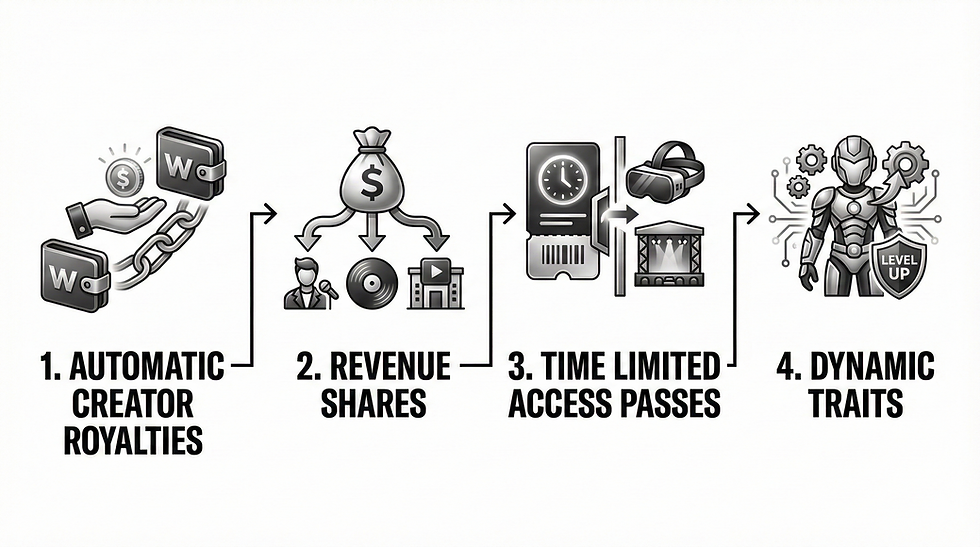
The most powerful aspect of NFTs in virtual worlds is not speculation, it is programmability. Smart contracts can encode how value flows whenever a token moves.
Examples relevant to metaverse production:
Automatic creator royalties on secondary sales of land or items
Revenue shares between a performer, label, and studio for avatar appearances
Time limited access passes to immersive experiences or live performances
Dynamic traits that unlock based on in world actions or achievements
Music is a clear case. A track performed by a digital human inside a virtual venue can be wrapped in a token that also carries specific rights and royalty logic. Music NFTs have been proposed as a way for artists to reclaim more direct control and revenue, shifting away from traditional label dominated contracts.
For a detailed breakdown of how different music NFT structures can encode formats, access tiers, and rights, see Mimic’s analysis of music NFT formats, which looks at how audio assets can be structured for both collectors and live immersive delivery.
Inside an nft metaverse, these mechanisms turn static items into live financial instruments, but they also raise legal and ethical questions. What jurisdiction applies. How are minors protected. What happens when a platform changes its royalty rules.
Building on chain ready characters and assets

For a studio creating digital humans, creatures, or props that will live in virtual worlds, preparing for on chain ownership is a design decision, not an afterthought.
Key considerations in the pipeline:
Rights and likeness clearance
Clear agreements with performers regarding digital doubles and AI driven performances
Explicit rules on where a likeness may appear and for how long
Contractual boundaries around derivative works and user generated variants
Technical representation
A production master model for offline rendering
Optimized real time versions for engines powering immersive experiences
A clear mapping between token metadata and the correct asset versions
Metadata and structure
Descriptive tags for rig type, skeleton, and animation sets
References to file storage with redundancy and long term reliability
Versioning logic when an avatar or environment is updated
Smart contract design
Royalty logic that matches real world contracts
Access rules for private spaces, screenings, or performances
Emergency controls for revoking or freezing problematic items in line with law and safety
Studios offering complete nft metaverse pipelines often bundle creative, technical, and contractual thinking into one process. Mimic’s own service offering is an example of that integrated approach, covering character creation, scanning, mocap, and token ready asset delivery as part of their NFT and avatar services.
Behind that production work sits a technology stack dedicated to real time facial animation, body motion, and engine integration. For teams looking to understand how high fidelity avatars can operate across both cinematic and interactive contexts, Mimic’s overview of its real time character technology provides a useful reference point.
Comparison table
Model | Core idea | Trade offs |
Platform controlled items | Items live only in one platform database, access is governed by that platform | Simple and predictable, but no portability and limited resale outside operator rules |
Tokenized assets inside one world | NFTs track ownership on chain, but utility stays inside one virtual world | Easier secondary markets, but rights and usefulness still depend on that world’s terms |
Cross platform interoperable tokens | Tokens and assets use shared formats so multiple worlds can recognize them | More portable ownership, but every platform can still restrict use, legal rights stay contract driven |
Applications across entertainment and XR

Tokenized ownership in virtual spaces is not confined to collectibles. It touches almost every part of visual storytelling and interactive media.
Film and episodic storytelling
Virtual production assets that continue to live as collectible versions of sets or props
Digital cameos by AI driven characters at premieres or fan events gated by tokens
Limited edition story branches accessible only to holders of certain passes
Games and live service worlds
Player owned land that can host user created games, galleries, or venues
Limited series skins and wearables with on chain provenance
Community governed spaces where token holders vote on curation or events
Music and performance
Virtual concerts where access tiers map to different music NFT holdings
Persistent venues where artist branded avatars perform in real time
Recorded mocap performances sold as unique or editioned collectible experiences
XR installations and location based experiences
Physical installations where a visitor claims a token that unlocks a digital twin space
Hybrid performances where a scanned performer appears both on site and inside a virtual world, with ownership of digital mementos recorded on chain
For studios operating across physical and digital presence, the nft metaverse offers a way to synchronise ownership across both spaces. The token becomes the connective tissue between real world events and ongoing immersive experiences.
Benefits of tokenized virtual assets

When designed carefully, token based ownership in virtual worlds can deliver concrete advantages for both creators and audiences.
For creators and rights holders
Direct relationships with collectors and fans instead of pure platform dependency
Programmable royalties on secondary transactions where local law and marketplace rules allow it
Clear provenance for high value assets like hero avatars and iconic props
New storytelling tools that let assets evolve based on on chain history
For audiences and participants
Stronger sense of ownership and continuity across sessions and devices
The ability to trade or gift assets in open markets rather than being locked into a single store
Transparent edition counts and history for scarce items
Deeper connection to performers and brands, especially when tokens gate real immersive experiences
For platforms and ecosystems
New economic layers built around user creativity and co creation
Shared standards that can reduce the cost of integrating external assets
Ways to align long term users and contributors via governance or loyalty tokens
None of this is automatic. It depends on clear contracts, thoughtful UX, and responsible technical choices.
Challenges

The current landscape is still noisy and uneven. Serious teams treat the nft metaverse not as a trend but as a set of tools that must be reconciled with law, ethics, and human experience.
Key challenges include:
Legal uncertainty:
Courts and regulators are still shaping how token based ownership interacts with copyright, consumer protection, and financial regulation. Artists and buyers often assume that owning an NFT means owning full rights to the underlying work, which is usually not the case.
Platform risk:
Even when ownership is on chain, utility depends on platforms choosing to recognize that token. If a world shuts down or bans a contract, the asset becomes more like a static collectible than a living part of immersive experiences.
Technical fragility:
Media files referenced by tokens can suffer from link rot if storage is not handled correctly. Token metadata standards evolve. Engine updates can break older assets that were not designed with forward compatibility in mind.
Ethical and consent issues:
Digital humans and AI driven performances raise profound questions about consent, longevity, and control. Tokens should never be used as a shortcut to bypass performers’ rights or to lock a likeness into uses they did not agree to.
Market volatility and reputation:
Speculative bubbles around NFTs have harmed trust and obscured the underlying utility. Teams working on long term projects need to separate short term price action from durable value creation in virtual worlds.
Future outlook

In the near term, several trends are likely to shape ownership inside virtual worlds:
Clearer legal templates: Standardized contracts that tie NFTs to well defined licenses for art, avatars, and performances, with jurisdiction and dispute resolution built in.
Better storage and metadata practices: More consistent use of decentralized storage, versioning, and rich metadata that describes rigs, animation sets, and rights.
Interoperable avatar and asset standards: Wider adoption of common skeletons, facial rigs, and material conventions that make it easier to move a digital human between engines without compromising quality.
Deeper integration of AI: AI driven behaviors and performances linked to tokenized characters, where ownership covers not only the static mesh but the ongoing personality and interaction patterns, under strict consent frameworks.
Convergence of physical and virtual ownership: Physical props, costumes, and performances linked to virtual twins in metaverse spaces, with tokens bridging both sides and recording history across formats.
Studios that already live at the intersection of film, game engines, and real time performance, such as Mimic and the Mimicverse ecosystem, are well placed to define best practices. Their broader mission, outlined on the Mimic NFTs homepage, is not to chase every trend but to build durable digital beings and worlds that respect both craft and consent. For more detail on the people and philosophy behind that approach, see their background story on the about page.
FAQs
Do I own the character itself if I buy an avatar NFT?
Usually you own the token and the specific rights granted in its license. You do not automatically own the underlying 3D files, rig, or likeness in a way that lets you do anything you want.
Can my avatar move freely between different virtual worlds?
Only if other platforms choose to support that asset and if the avatar has been built to match their technical and policy requirements. Ownership on chain does not force a platform to load or display an asset.
If a virtual world shuts down, do I lose my land NFT?
You still own the token on chain, but if no other world maps that token to a new environment, its utility becomes purely symbolic or collectible.
How are royalties enforced when tokens are traded?
Marketplaces implement the royalty rules defined in the smart contract or their own systems. Enforcement is not guaranteed everywhere, and legal contracts still matter more than code alone.
Can a performer or brand take back control of a tokenized avatar?
That depends on the original agreements and how the contracts were written. Responsible projects include clear termination, sunset, and update clauses so that performers are not locked into unwanted uses of their likeness.
Is every immersive experience better with NFTs?
No. For many projects, traditional authentication or platform based inventories are simpler. Tokens make sense where persistence, secondary markets, or cross world identity are core to the creative vision.
Conclusion
Ownership inside the nft metaverse is neither pure marketing fantasy nor a solved technical problem. It is a negotiation between code, contract, and creative intent.
For creators, studios, and rights holders, the task is to design assets and immersive experiences that respect performers, leverage real time technology, and use tokens where they genuinely add value. For audiences, it is about understanding what is truly owned, what is rented, and what depends on the health of the worlds they choose to inhabit.
When digital humans, environments, and stories are built with that clarity, virtual ownership can move beyond speculation and become a stable foundation for long form, emotionally resonant experiences that live across media and time.

Comments