
NFT for Beginners: Wallets, Ownership, and Common Mistakes
- Mimic NFTs
- Jan 20
- 11 min read

If you are holding your first crypto wallet screen and wondering whether it is safe to click confirm, this NFT for Beginners guide is for you. We will stay close to the practical questions that matter on day one: how wallets work, what ownership really means, and which mistakes empty wallets faster than any market swing.
At Mimic NFTs, we spend our time turning real performers, objects, and stories into digital assets three dimensional scans, motion captured characters, and immersive scenes that live on chain and inside engines. That work only makes sense when collectors and artists can trust how those tokens are stored and transferred. This article distils that production grade perspective into a calm, clear starting point.
You will not find hype here. Just a grounded path from your first wallet setup to making your first informed purchase, with enough context to understand what you are actually buying and how to protect it.
Table of Contents
Throughout the guide, we will connect these basics to how a studio like Mimic NFTs builds and maintains serious digital asset ecosystems for artists, brands, and collectors.
What an NFT actually is

A non fungible token is a unique record on a blockchain. It proves that a specific wallet currently controls a specific entry in that ledger, and that entry points to some underlying asset such as an image, video, three dimensional character, piece of music, or access right.
Three ideas matter more than the buzzwords:
The token is the proof of ownership
The media file usually lives somewhere else, often on distributed storage or a managed platform
The rights attached to that token depend on the legal and creative framework, not just on code
Most introductory material treats NFTs as simple pictures. For a more detailed look at how tokens can represent full three dimensional characters and digital humans, you can explore Mimic’s article on digital NFTs for three dimensional characters and digital humans.
If you keep this mental model in mind token, media, rights the rest of this guide will feel much simpler.
Wallets as your identity in web three

A wallet is not a literal container for coins or art. It is more like a keyring and passport combined.
At a technical level, a wallet manages three things:
A private key that must never be shared
A public address that others can use to send you assets
A signing mechanism that lets you approve or reject transactions
When you connect a wallet to a marketplace, you are essentially saying I am this address and I approve this specific action. Every purchase, every listing, every signature uses that private key under the hood.
For artists and studios who work with Mimic, that wallet is the anchor for everything from minting a collection of digital humans to granting access to an immersive show built in a real time engine. The same rule applies whether you are handling a single profile picture or an entire three dimensional character drop if you cannot control your wallet, you cannot control your assets.
Main types of wallets and how they differ

There are four core approaches you will see in every NFT for Beginners discussion, even if the labels change slightly from platform to platform.
Custodial accounts on exchanges or platforms
Here, an exchange or marketplace holds the keys on your behalf. You log in with an email and password, and they manage the blockchain interactions in the background.
Easiest onboarding
Often limited NFT support and flexibility
You rely entirely on the platform’s security and policies
Custodial setups can be useful while you are exploring, but they are not ideal if you plan to hold serious art or long term collections, especially when those assets are tied to real world performances, scans, or bespoke character work.
Browser or desktop wallets
These run as browser extensions or desktop apps. You control the keys, usually via a seed phrase written down or stored offline.
Full control over your assets
Direct connection to most major marketplaces and dapps
Requires more care with backups and security
For many first time collectors, this is the first real step into web three. It is also where most security mistakes happen, which we will address later.
Mobile wallets
Mobile wallets live on your phone and often combine crypto, NFTs, and basic portfolio tools.
Convenient and always accessible
Can act as a signer for desktop sessions
Risk of loss if your phone is compromised and you lack proper backup
Mobile wallets are useful for casual interaction, in person events, and scanning QR codes at galleries or exhibitions, something we see often when physical installations are linked to digital tokens.
Hardware wallets
A hardware wallet is a small device that keeps your keys separate from your computer or phone. Transactions are signed on the device itself, which reduces the attack surface.
Strong protection for long term holdings
Slightly more friction for everyday use
Best paired with a hot wallet for daily activity
For artists working with Mimic on high value drops, or for collectors building serious archives of digital humans and three dimensional worlds, a hardware device is standard practice rather than a luxury.
Setting up your first wallet

The practical path for an entry level collector is to start with a reputable non custodial wallet, then layer on stronger protection as your holdings grow. Here is a simple sequence.
Choose your main network: Most creative projects still mint on Ethereum and its compatible chains, though alternatives exist. Begin where the marketplaces and communities you care about are most active.
Select a trusted wallet: Pick a widely used wallet that supports NFTs on your chosen network. Install it only from the official site or app store. Avoid any download links sent through private messages.
Create and store your seed phrase: The seed phrase is the master recovery key for your wallet. Write it down clearly, store it in at least two separate secure locations, and never type it into any website, chat, or support form. No legitimate service will ever need it.
Set strong access controls: Use a complex password and enable biometric or device level protection where available. A password manager can help you generate and store unique credentials.
Fund your wallet slowly: Move a small amount of cryptocurrency first. Practice sending funds between your own addresses and signing simple transactions before moving larger amounts or buying higher value tokens.
Bookmark marketplaces and tools: Always access marketplaces and portfolio tools from your own bookmarks or from links on official project pages. Many phishing attacks rely on nearly identical web addresses and rushed clicks.
For an NFT for Beginners audience, this may feel like a lot of ceremony around a simple art purchase. In practice, the ceremony saves you from the most common ways people lose assets. Once it becomes habit, actual collecting feels straightforward.
What ownership really means with NFTs
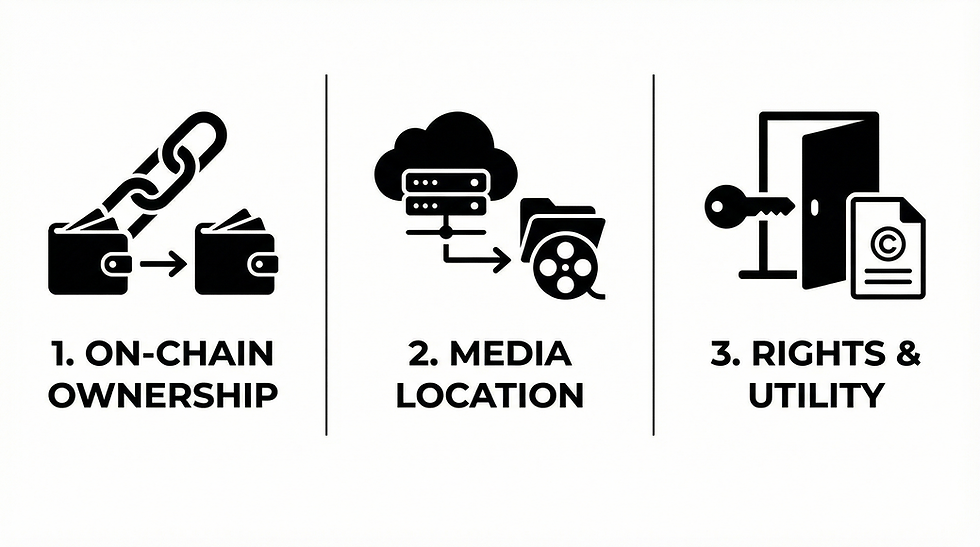
When you buy an NFT, several layers move at once.
On chain ownershipThe token moves from the seller’s address to yours. The blockchain records this change, and anyone can verify it.
Media locationThe token usually points to a media file or bundle. That might live on a decentralised network such as IPFS, on a studio’s asset server, or on a platform that combines both.
Rights and utilityThe project decides what that token entitles you to view only access, commercial rights, access to a community, entry to an immersive show, or a blend of these.
At Mimic, a single token might be linked to a three dimensional scan of an artist, a rigged character ready for real time engines, and a set of motion captured performances. In that case, ownership is not just about a still image. It is about controlled access to assets that can move, speak, and appear in games, XR spaces, or metaverse stages.
Our wider ecosystem, described on the about the Mimic team page, is built around keeping those connections between token, media, and rights stable over time rather than chasing short term drops.
If you want a clean conceptual primer without hype before diving deeper, you can also read the Mimic blog’s clear explanation of what NFTs are, then return to this guide for the wallet focused details.
Common mistakes for new collectors

The most painful stories in any NFT for Beginners community tend to follow the same patterns. You can avoid most of them by recognising these traps in advance.
Mistake one treating a custodial platform as a secure vault
Keeping your entire collection on a single exchange or marketplace account means your access depends on their security, policies, and uptime. If the platform freezes withdrawals, changes direction, or suffers a breach, your assets are at risk.
Better practiceUse custodial setups for exploration only. Move assets you care about into a wallet where you hold the keys, and consider a hardware device once the value justifies the extra step.
Mistake two weak seed phrase habits
Writing your recovery phrase in a notes app, email draft, or shared cloud document is effectively the same as leaving it on a public wall. Many thefts begin with a compromised device or cloud account rather than a clever attack on the blockchain itself.
Better practiceRecord the phrase offline, keep multiple copies in separate secure places, and treat any request to enter it into a web page as an immediate red flag.
Mistake three blind transaction approvals
Modern wallets show clear prompts describing what you are agreeing to, but it is still easy to click through on autopilot. Some malicious contracts request permission to transfer all tokens of a certain type from your wallet, not just the one you intend to trade.
Better practiceRead every prompt before signing. If the wording is unclear, cancel and research the action. Only connect your wallet to sites you trust, and disconnect when you are done.
Mistake four mixing experimentation and long term storage
Using the same wallet for testing new platforms, minting random free collections, and storing high value pieces increases risk. One compromised dapp can put everything at stake.
Better practiceMaintain at least two wallets
One for experimentation and lower value activity
One for art, character work, and access passes you truly want to preserve
For Mimic projects, we routinely design flows around this separation, with one wallet acting as a collector’s public identity and another as the quiet vault for rare digital humans, key scenes, and high value passes.
Mistake five assuming every token grants full rights
Buying an NFT rarely gives you automatic control over the underlying intellectual property. Use rights, commercial rights, and licensing vary from project to project.
Better practiceAlways read the rights and licensing terms. Serious studios, including Mimic, treat this as part of the creative design, not a footnote, and will state clearly what holders can do with their characters, scenes, or music.
Comparison table
Path one. Platform account | Path two. Browser or mobile wallet | Path three. Hardware layered setup | |
Control | The platform controls the keys and acts on your behalf. | You own the keys and sign every action. | You keep keys on a dedicated device and use a hot wallet as a bridge. |
Safety | Protected by the platform’s security, but exposed to its business risk and any policy change. | Strong if you protect your device and seed phrase. Vulnerable to phishing and rushed approvals. | Highest practical protection for most individuals, provided you still verify what you sign. |
Effort | Very low. You log in, click, and the platform does the rest. | Moderate. You manage backups, gas fees, and network settings. | Slightly higher. You manage an extra device and a more deliberate signing flow. |
Best for | First curiosity and very small purchases while you learn the basics. | Active collectors, artists minting their own work, and anyone using NFTs for access to communities and events. | Serious art collections, high value tokens representing digital humans or three dimensional worlds, and long term holders. |
Applications for artists, brands, and fans

Once wallets and ownership basics are clear, NFTs become a flexible tool rather than a mystery. A few real production scenarios.
Musicians linking songs to animated three dimensional stage personas, where each token unlocks access to private listening sessions or live XR performances
Fashion houses minting digital garments for avatars, with holders invited to physical events and metaverse showcases
Game studios working with Mimic to scan actors, rig characters, and capture performance, then linking playable avatars to collectible tokens that fans can own across titles
Galleries combining physical installations with token based access, where a visitor scans a QR code, mints a piece, and later experiences the same work in a virtual environment
If you are planning a structured project rather than a single experiment, it is worth exploring Mimic’s NFT services for artists and brands which cover the full path from concept and character creation through to minting, access logic, and ongoing management.
Benefits of NFTs when done properly

When the technical and legal foundations are sound, NFTs offer concrete advantages over traditional digital distribution.
Verifiable ownership: Blockchain records make provenance transparent, from the original mint through to each resale.
Programmable access: Tokens can grant entry to events, unlock special scenes or levels, or act as membership passes, using the same smart contract logic used in large Mimic productions.
Alignment between creator and collector: Royalties on secondary sales can reward artists when their work gains value over time, although this depends on marketplace support and legal structure.
Richer media formats: A single token can reference high resolution images, film quality animation, three dimensional scans, and real time assets, all coordinated through a coherent asset pipeline.
Cross platform potential: As more engines and platforms adopt standard token formats, your assets can move more easily between games, galleries, and immersive environments.
Future outlook

The conversation around NFTs is already shifting. The short lived rush for quick profile picture flips is making room for quieter, more durable structures.
In the near future, expect to see
More projects using tokens as passes for concerts, screenings, game seasons, and XR installations
Stronger links between on chain identity and off chain experiences, from museum visits to virtual meet and greets with digital doubles
Clearer separation between collectible art, access passes, and regulated financial instruments
Deeper collaboration between creators, legal teams, and production studios so that characters, environments, and rights remain coherent across formats
For a studio like Mimic, the focus is on continuity. A digital human scanned today should still make sense when engines, devices, and networks evolve. Tokens become one part of that long arc, not the whole story.
FAQs
1. Do I need cryptocurrency before I can buy my first NFT?
Usually yes. Most marketplaces require you to hold the relevant cryptocurrency in your wallet to pay for both the asset and network fees. Some platforms now offer card based on ramps that handle this conversion for you behind the scenes, but having a basic understanding of how crypto flows into and out of your wallet will make you far more resilient.
2. Which wallet type is safest for my first purchase?
For your first low value experiment, a well known browser or mobile wallet is usually enough, provided you follow the security steps in this guide. As your holdings grow, moving long term pieces to a hardware backed setup offers a much stronger guarantee against device level compromise.
3. Can I lose my NFT if a marketplace closes?
If you used a true non custodial wallet, the token remains in your address even if a marketplace disappears. What you might lose is easy access to the associated media or utilities if the project relied solely on that platform. This is why serious teams separate token logic, media storage, and delivery infrastructure, rather than tying everything to a single site.
4. How much should I spend on my first NFT?
There is no fixed number, but a conservative approach is simple spend an amount that would not hurt to lose entirely. Focus less on speculation and more on learning the flow wallet setup, small purchases, transfers, and security checks. Once those motions feel natural, you can decide whether you want to collect more seriously. Nothing in this guide is investment advice it is a safety and literacy primer.
5. Where can I learn more about NFTs in a creative context?
If you want a deeper narrative around how tokens intersect with digital humans, three dimensional characters, and immersive experiences, start with Mimic’s own resources. The main Mimic NFTs site covers who we are and how we work across scanning, motion capture, rigging, and real time engines, while the broader blog series expands on ownership, metaverse presence, and artist focused formats.
Conclusion
Treat this NFT for Beginners guide as a foundation rather than a finish line. If you understand what a token represents, how a wallet secures your identity, and which simple habits prevent most losses, you are already ahead of a large part of the market.
From there, the space becomes less about jargon and more about craft. For Mimic and for other serious studios, the real work sits in capturing performances, sculpting digital humans, rigging characters for real time engines, and weaving them into experiences where ownership actually matters. Tokens are simply the connective tissue between that work and the people who care about it.
Move slowly, secure your keys, read what you sign, and choose projects that respect both your attention and your safety. The technology should fade into the background so that art, story, and performance can take the front of the stage.


Comments