
NFT Art in 3D: What Makes 3D Collectibles Different
- Mimic NFTs
- Jan 29
- 10 min read
NFT Art in 3D is where digital collectibles stop behaving like flat images and start behaving like characters, objects, and environments you can inhabit. For a studio used to film grade digital humans, it is less about speculation and more about: how does this asset perform when it moves, when it speaks, when it has to live inside a metaverse experience, a game world, or an immersive installation.
This article looks at NFT Art in 3D from a production perspective. How the pipeline differs from two dimensional drops. Where the costs and risks sit. What makes a three dimensional collectible actually feel worth owning beyond the mint. And how all of this ties into metadata, file formats, and long term interoperability across engines and platforms.
Table of Contents
What is NFT Art in 3D

At a blockchain level, NFT Art in 3D is identical to any other non fungible token: a unique entry on a chain that points to some form of media plus metadata. What changes is the nature of that media. Instead of a flat render or illustration, the primary asset is a three dimensional model, often animated, often rigged, and increasingly designed to be interactive in real time environments.
If you need a clear baseline on what NFTs are before going deeper into three dimensional work, you can start with a plain language overview of how non fungible tokens work and how they differ from regular digital files, then come back to this article once that foundation is solid. That fundamental explanation of NFTs as verifiable ownership certificates rather than the media itself is well covered in a general introduction to the space on the Mimic blog.
Once you bring volume, topology, texture, lighting, and motion into the equation, NFT Art in 3D stops being a graphic design problem and becomes a full CG pipeline discipline. Polygon counts, shader choices, texture atlases, blendshapes, and skeleton hierarchies suddenly define what is technically possible on chain and on device.
How 3D collectibles differ from 2D collections

Most early NFT collections were flat images or very light image sequences. They were easy to mint, easy to preview in a browser, and simple to understand as a grid of profile pictures. Three dimensional assets behave differently at almost every stage.
Key differences include
Volume and parallax: Three dimensional collectibles have true depth. A character can turn, lean, sit, dance, or occupy a space. This gives collectors more to explore but demands far more from the artists and engineers building the asset.
Interactivity: A 3D collectible can respond to input, react to audio, or be driven by motion capture data in real time engines. That means rig quality, skinning, and animation systems suddenly sit at the center of the creative value.
Technical constraints: Static images rarely hit platform limits. Three dimensional characters and environments immediately run into poly budgets, draw calls, GPU and mobile constraints. The same NFT may need multiple levels of detail and different format variants for mobile, desktop, VR, or holographic display.
Production time and cost: Where a two dimensional collection can be generated from layered traits, NFT Art in 3D typically needs actual modeling, UV work, texturing, rigging, animation, and sometimes facial performance capture. You gain depth, but you commit to real production.
If you want to understand the underlying logic of digital collectibles versus the tokens that represent them, it helps to first separate the concept of the media file from the blockchain proof of ownership. A detailed breakdown of that distinction for static NFTs also applies here, even when the underlying asset is fully three dimensional.
Inside a production pipeline for 3D NFT collectibles
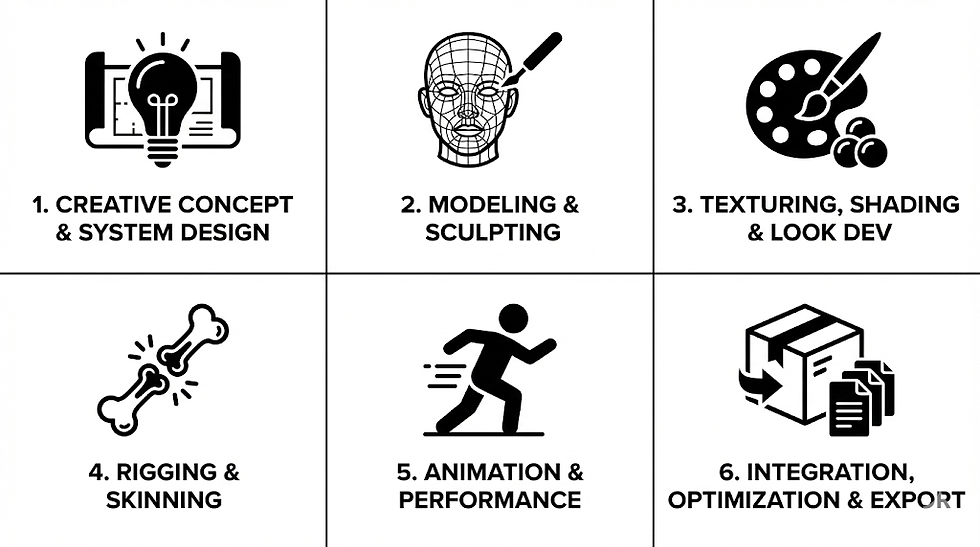
For a studio working at film and high end game level, a typical pipeline for NFT Art in 3D looks like this
1. Creative concept and system design
Before any modeling, the team defines
The universe or brand world the collectibles belong to
Whether assets are characters, props, architecture, or full scenes
The level of realism versus stylization
Target platforms and engines for real time use
Which traits and rarities will genuinely change the experience rather than just the appearance
At this stage it is useful to reference the broader Mimicverse framework, where digital humans and characters are treated as persistent entities that can move between experiences rather than one off drops living only on a marketplace.
2. Modeling and sculpting
Artists block out and refine the base mesh in software like Maya, Blender, or ZBrush. For character driven collections this often builds on scan data for accurate anatomy or facial proportion libraries derived from previous performance capture projects.
Topology is planned for
Clean deformation during animation
Efficient subdivision
Reasonable file sizes for WebGL and mobile
3. Texturing, shading, and look development
Texture artists create albedo, normal, roughness, and metalness maps or use procedural workflows. For collectibles expected to run in engines like Unreal or Unity, shading is developed with the constraints of those engines in mind so that the minted preview and the live avatar feel consistent.
This is also where traits like skin variants, outfits, accessories, and environmental states are defined as reusable material or mesh sets, rather than purely two dimensional overlays.
4. Rigging and skinning
For animated collectibles, a proper skeleton is created with controls for body, face, and sometimes cloth or hair. Weight painting is critical, especially if the NFT will later drive an avatar in the Mimicverse or another metaverse environment.
High quality rigging is the difference between a collectible that can simply be rotated in a viewer and one that can perform, emote, and respond to real time inputs or motion capture streams.
5. Animation and performance
Some three dimensional NFT collections ship with baked animation loops, others with a library of motion clips, and some with the ability to receive live performance via motion capture or webcam tracking.
A studio grade pipeline will
Capture human performance where expressiveness matters
Use procedural or physics based motion for crowds or secondary animation
Ensure animations loop cleanly for galleries and marketplace previews
6. Integration, optimization, and export
Before minting, the asset must be
Reduced into platform specific LOD variants
Exported into agreed formats such as GLB, FBX, or USDZ
Tested across target engines and devices
Here the relationship between the media files, their content, and the on chain record becomes critical. If you want a deeper treatment of how digital files and ownership structures interact in NFT environments, the Mimic article on digital NFTs and experience design is a useful companion piece, especially when applied to three dimensional content.
File formats, metadata, and performance constraints

Three dimensional NFTs are only as future proof as their metadata. While a JPEG can survive a lot of ecosystem change, a complex CG asset needs its structure described carefully.
Key elements often include
Primary asset file such as GLB, FBX, or USD based container
Animation clips linked either inside the main file or as separate resources
Texture sets at different resolutions for different uses
Engine specific variants if the same asset is intended for several runtimes
Usage rights and constraints clearly written into descriptive fields
If you want a deeper dive into how metadata fields work, how token URIs relate to storage, and how attributes affect searchability and rarity, the dedicated article on NFT metadata gives a more technical foundation that directly applies to three dimensional work as well.
For NFT Art in 3D, the metadata layer becomes a routing map. It tells marketplaces how to preview the asset, tells wallets which fallback render to show, and tells external applications where to find the real time ready version versus the cinematic render.
Display surfaces for NFT Art in 3D

A flat laptop screen is the least interesting way to experience three dimensional collectibles. Once you have rigged, animated, and optimized the asset, it can be surfaced across multiple contexts
Real time engines for interactive experiences
XR headsets for immersive galleries
Mobile AR for placing characters and props into physical space
Large scale projections or LED stages for live events
Social and streaming overlays where the NFT becomes a real time avatar
The Mimicverse concept extends this by treating NFT Art in 3D as a passport between worlds. A collector is not just buying a file, but gaining a character or object that can appear inside different chapters of a shared virtual universe.
If you want to explore how these virtual environments connect back to collectibles and community, the Mimicverse overview page outlines how digital humans, AI, and NFTs converge into a single connected ecosystem.
Comparison table
Aspect | Two dimensional collectibles | NFT Art in 3D |
Visual language | Flat image or sprite sheet, expressive but limited to fixed views | True volume with parallax, supports camera movement, closeups, and multiple angles |
Production pipeline | Illustration and graphic design, traits layered as images | Full CG pipeline including modeling, rigging, animation, and rendering |
Utility and interaction | Strong as identity icons and static collectibles, interaction handled externally | Suited for avatars, game ready assets, and interactive or AI driven experiences |
Technical complexity | Simple storage and delivery, easy marketplace and wallet support | Larger files, more dependencies, requires optimization and engine compatibility |
Applications of NFT Art in 3D
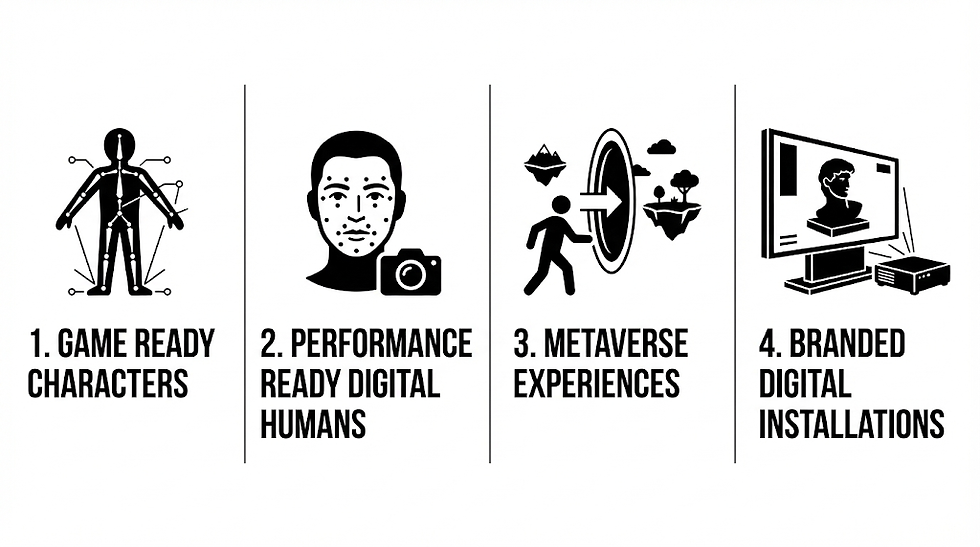
NFT Art in 3D becomes particularly powerful when it leaves the marketplace grid and enters live experiences.
Game ready characters and props
Three dimensional NFTs can be designed as fully rigged game assets. With proper optimization, they can enter partner titles, custom experiences, or owner specific mini games. Many projects already treat their collections as early access keys to future interactive content and worlds.
Performance ready digital humans
For projects that lean into photoreal avatars, NFT Art in 3D can encapsulate a full digital human stack
Scan based head and body geometry
Facial rigging compatible with performance capture
High fidelity shaders tuned for film and real time engines
Library of base motions and facial expressions
This allows collectors to own not just a static portrait, but a character that can perform in live streams, music videos, or immersive theatre experiences.
Metaverse and Mimicverse experiences
Three dimensional collectibles become natural citizens of shared virtual spaces. Inside metaverse style environments, an NFT can
Act as your avatar or companion
Unlock specific locations or scenes
Drive custom interactions at events and concerts
A dedicated piece on NFTs in metaverse contexts explores this further, including the relationship between token design, world building, and community participation. Those principles apply even more strongly when the assets are fully three dimensional.
Branded digital installations
Brands can commission limited series NFT Art in 3D pieces that exist simultaneously as
Physical installations driven by projections or LED
XR experiences available to collectors
Marketplace collectibles with on chain provenance
For this style of work, the studio pipeline looks closer to film or high end commercial VFX, with careful lighting, camera choreography, and shot based storytelling.
Benefits of NFT Art in 3D

From a professional production standpoint, NFT Art in 3D offers several clear advantages when executed correctly
Deeper emotional presence: Three dimensional characters can look back at you, react to your movement, and inhabit a shared space. That sense of presence creates stronger emotional bonds than a static image can.
Reusable assets across mediums: A well built three dimensional asset can feed into film, game, XR, and live event pipelines. One production investment supports multiple channels, from real time avatar performances to pre rendered cinematics.
Richer trait systems: In 3D, traits can change silhouette, movement style, facial performance, and audio behavior, not just color or accessory. This allows for more meaningful rarity without resorting to arbitrary graphic swaps.
Higher ceiling for utility: Once an NFT can exist as a controllable character or functional object, it naturally supports tickets, access rights, in world abilities, and AI assisted behaviors. The token becomes part of a living system, not simply a receipt for a static image.
Future outlook for NFT Art in 3D

As real time engines, XR devices, and AI systems mature, NFT Art in 3D is likely to move in several directions simultaneously
More expressive real time avatars: Expect NFTs that can plug directly into live performance systems, allowing collectors to embody their characters in calls, streams, and mixed reality shows with studio level facial and body capture driving the animation.
Standardized three dimensional formats for collectibles: Work around open standards such as glTF and USD is already making it easier to move assets between engines and platforms. Three dimensional NFTs stand to benefit greatly from this convergence.
Persistent characters across ecosystems: Projects like Mimicverse point toward a future where your NFT is not a single asset but a pers appear in films, games, virtual concerts, and private experiences, with state and narrative built over time.
Tighter coupling between AI and ownership: As AI systems take on more of the behavioral logic for digital characters, NFTs can anchor identity, rights, and continuity. A collector might own a specific AI driven persona embodied in a recurring avatar, with on chain rules defining how it evolves.
The common theme is this: NFT Art in 3D is moving away from speculative collectibles toward performance ready digital entities. That trajectory aligns closely with long term investment in performance capture, rigging, and cinematic character work.
FAQs
Is NFT Art in 3D only for games and metaverse projects?
No. While three dimensional collectibles are natural fits for games and shared virtual spaces, they also work in music, fashion, fine art, architecture, and live performance contexts. Any project that benefits from volumetric presence can use them.
Do all three dimensional NFTs need to be fully rigged?
Not necessarily. Static sculptures, architectural studies, and product visualizations can be powerful even without animation. Rigging becomes essential once you expect motion, interactivity, or avatar use.
Which file format is best for NFT Art in 3D?
There is no single best format. GLB is common for web previews and lightweight experiences. USD and FBX are frequently used inside production pipelines. The important point is to define a clear standard per project and express it in metadata so tools and platforms know which variant to load.
How does NFT metadata affect three dimensional collectibles?
Metadata describes where files are stored, how traits are defined, and which versions of an asset exist. For NFT Art in 3D, it also acts as a routing layer between cinematic renders, real time versions, and fallback previews. A well structured metadata schema ensures that collectors, platforms, and future applications can all locate and use the correct asset.
Where should brands start if they want to commission NFT Art in 3D?
The practical first step is defining the role of the collectible in your broader ecosystem. Is it a character, a key, a performance, or a long term digital human. From there, a production partner can shape the pipeline, formats, and rights structure. For a detailed overview of how Mimic structures its services around digital humans, virtual production, and NFT related experiences, the services overview gives a clear snapshot of capabilities.
Conclusion
NFT Art in 3D is not simply a trend from the early days of the token boom. It is the natural meeting point of high end character work, real time engines, and verifiable digital ownership. When treated seriously, a three dimensional collectible is closer to a performance ready character than a static asset.
For production teams, that means thinking in terms of pipelines, not drops. For collectors, it means understanding that the most interesting NFTs will be the ones that can move, speak, and persist as part of a larger narrative world. And for brands, it means approaching NFT Art in 3D with the same rigor you would bring to a global campaign, a game launch, or a film.
Handled with craft and clear intent, these collectibles can anchor entire virtual universes rather than live as isolated files in a wallet.

Comments